Baseando-se no trabalho "Pseudoneoplastic Mimics of Prostate and Bladder Carcinomas" de Omar Hameed; Peter A. Humphrey, publicado na Arch Pathol Lab Med. 2010;134:427–443; a Dra. Juliana Paulino irá abordar o tema das lesões pseudoneoplásicas, no âmbito da uropatologia, nesta sexta.
30/04
16:30h - Dra. Juliana Paulino:"Pseudoneoplastic Mimics of Prostate and Bladder Carcinomas". Omar Hameed; Peter A. HumphreyArch Pathol Lab Med. 2010;134:427–443
17:15h - Discussão de Casos da Rotina
18:10h - Diego Tardelli e Thiago Ribeiro. Présence dans la surface de réparation et la possibilité de le défenseur. Analyse des caractéristiques phénotypiques de l'objectif. Revue Européenne des Sports, 2010.
quinta-feira, 29 de abril de 2010
segunda-feira, 26 de abril de 2010
Chocolate e depressão
-
http://archinte.ama-assn.org/cgi/content/short/170/8/699
-
We examined the cross-sectional relationship of chocolate consumption with depressed mood in adult men and women.
http://archinte.ama-assn.org/cgi/content/short/170/8/699
-
We examined the cross-sectional relationship of chocolate consumption with depressed mood in adult men and women.
CDC: DPDx Parasite Image Library
 From this page you can directly access all images contained in the DPDx Web site. DPDx is a web site developed and maintained by CDC’s Division of Parasitic Diseases (DPD).
domingo, 25 de abril de 2010
historical stuff #2
 Dr. Christopher D.M. Fletcher; Dr. Carlos Alberto; Dr. Frederico Melo; Dra. Luciana Gazzola; Dr. Mário Félix. Florianópolis-SC, Brasil, 2003. (Imagem gentilmente cedida por Dr. Mário).
sábado, 24 de abril de 2010
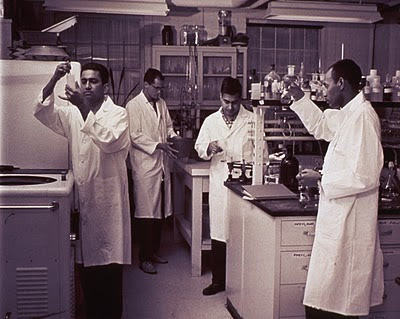

quinta-feira, 22 de abril de 2010
Guia dos Perplexos
Baseando-se em fatos reais e no trabalho "Selected Pseudoneoplastic Lesions of the Skin", o Dr. Moisés Salgado Pedrosa irá abordar o tema das lesões pseudoneoplásicas no âmbito da dermatopatologia, nesta sexta, 23/04.
16:30h - Dr. Moisés Salgado Pedrosa:
"Selected Pseudoneoplastic Lesions of the Skin"
Mark R. Wick; James W. Patterson
Arch Pathol Lab Med. 2010; 134: 369–377
17:15h - Discussão de Casos da Rotina.
18:10h - Norbert M Samuelson. Maimonides' Doctrine of Creation.
The Harvard Theological Review 84, n. 3, 1991: 249-271.
terça-feira, 20 de abril de 2010
Machiavelli's Laboratory
Livro disponibilizado eletronicamente em .pdf e, por isso, sem muita possibilidade de ser queimado no index librorum prohibitorum cave canem academicus cum brutis non est luctandum
-
--
Segue um fragmento irregular pardo-claro, firme e elástico do livro e os 10 pecados corriqueiros de todo bom cientista:
Segue um fragmento irregular pardo-claro, firme e elástico do livro e os 10 pecados corriqueiros de todo bom cientista:
-
This is a satirical book about science and ethics. All of the advice offered in this book is bad advice. Nothing in this book should be taken seriously. Literal-minded readers are urged to stop reading now.
-
... a few banal evils committed every day by respected scientists:
-
1. Boastfulness. Touting the positive qualities of your research, while omitting the problematic aspects. 2. Jealousy. Writing manuscripts that fail to cite the relevant and precedential work of your competitors. 3. Irresponsibility. Receiving a large federal grant but barely working on the project, preferring to spend your time garnering additional grants. 4. Arrogance. Refusing to release your research data to the public, insisting that others will misinterpret your findings. 5. Laziness. Co-authoring papers you haven't even read. 6. Deception. Hiding your financial conflicts of interest from your research subjects, colleagues, and editors; and profiting from your deceit. 7. Intimidation. Getting your way through an exercise of authority, rather than through scientific persuasion. 8. Cronyism. Using your influence to help your allies (by inviting them to speak at meetings, or by placing them in powerful positions), while you surreptitiously work to isolate or discredit scientists whose opinions or agendas conflict with yours. 9. Influence peddling. Using your authority and power to alter the course ofscientific advancement, in accordance with the wishes of a paying entity. 10. Rationalization. Justifying your actions through the self-serving use of a seemingly scientific argument that is illogical and wrong.
1. Boastfulness. Touting the positive qualities of your research, while omitting the problematic aspects. 2. Jealousy. Writing manuscripts that fail to cite the relevant and precedential work of your competitors. 3. Irresponsibility. Receiving a large federal grant but barely working on the project, preferring to spend your time garnering additional grants. 4. Arrogance. Refusing to release your research data to the public, insisting that others will misinterpret your findings. 5. Laziness. Co-authoring papers you haven't even read. 6. Deception. Hiding your financial conflicts of interest from your research subjects, colleagues, and editors; and profiting from your deceit. 7. Intimidation. Getting your way through an exercise of authority, rather than through scientific persuasion. 8. Cronyism. Using your influence to help your allies (by inviting them to speak at meetings, or by placing them in powerful positions), while you surreptitiously work to isolate or discredit scientists whose opinions or agendas conflict with yours. 9. Influence peddling. Using your authority and power to alter the course ofscientific advancement, in accordance with the wishes of a paying entity. 10. Rationalization. Justifying your actions through the self-serving use of a seemingly scientific argument that is illogical and wrong.
-
You may be thinking that there must be some exceptions; scientists and physicians who are altruistic. Actually, no, there are no exceptions. (grifo nosso). The hypothetical altruistic scientist would not last very long in an environment where competing ideas are marketed (promoted in grant applications), bought (through licenses and royalty payments and technology transfer agreements), sold (as high-priced pharmaceuticals and laboratory tests), banked (patented) and destroyed (by competition).
-
-
Jules Berman received his bachelor's degrees in Mathematics and in Earth and Planetary Sciences from MIT, his Ph.D. from Temple University, and his M.D. from the U. of Miami. He received post-doctoral training in the Laboratory of Experimental Pathology in the National Cancer Institute, at NIH and residency training at Geo. Washington U Med Ctr. He is board certified in anatomic pathology and in cytopathology. Jules Berman is now a free-lance writer. He has first-authored more than 100 scientific articles and has eight book titles in the fields of programming and cancer biology.

quinta-feira, 15 de abril de 2010
morsus irritatae necessitatis
Faremos um mês inteiro e contínuo sobre lesões "pseudo-neoplásicas", baseadas na pauta editorial da revista "Archives" do mês passado.
A primeira discussão será nessa sexta.
16:30h - Dra. Izabela Freitas
"Pseudoneoplasms of the Nervous System"
Kliment Donev; Bernd W. Scheithauer.
Arch Pathol Lab Med. 2010; 134:404–416
17:15h - Discussão de Casos da Rotina.
(Os casos pertinentes ilustrativos de lesões desta
ou daquela natureza serão muito bem vindos).
18:10h - "gravissimi sunt morsus irritatae necessitatis"
segundo Trad. de Sérgio Milliet:
"terríveis são as mordidas da necessidade excitada"
Pórcio Latrão, citado em Montaigne:
E, I, xlvii [t.I, p.407]
domingo, 11 de abril de 2010
Assinar:
Postagens (Atom)
-
Olho para uma Inteligência Artificial: mais-do-que-ver, pseudo- automação e a instauração de dados incertos na patologia digital
